How to Choose Hair Extensions That Match Your Bridal Hairstyle
You’ve chosen the dress. You’ve found the veil. You’ve saved approximately 47 versions of your dream hairstyle.
Then your hairstylist asks:
“Are you using extensions?”
Suddenly, there’s another decision.
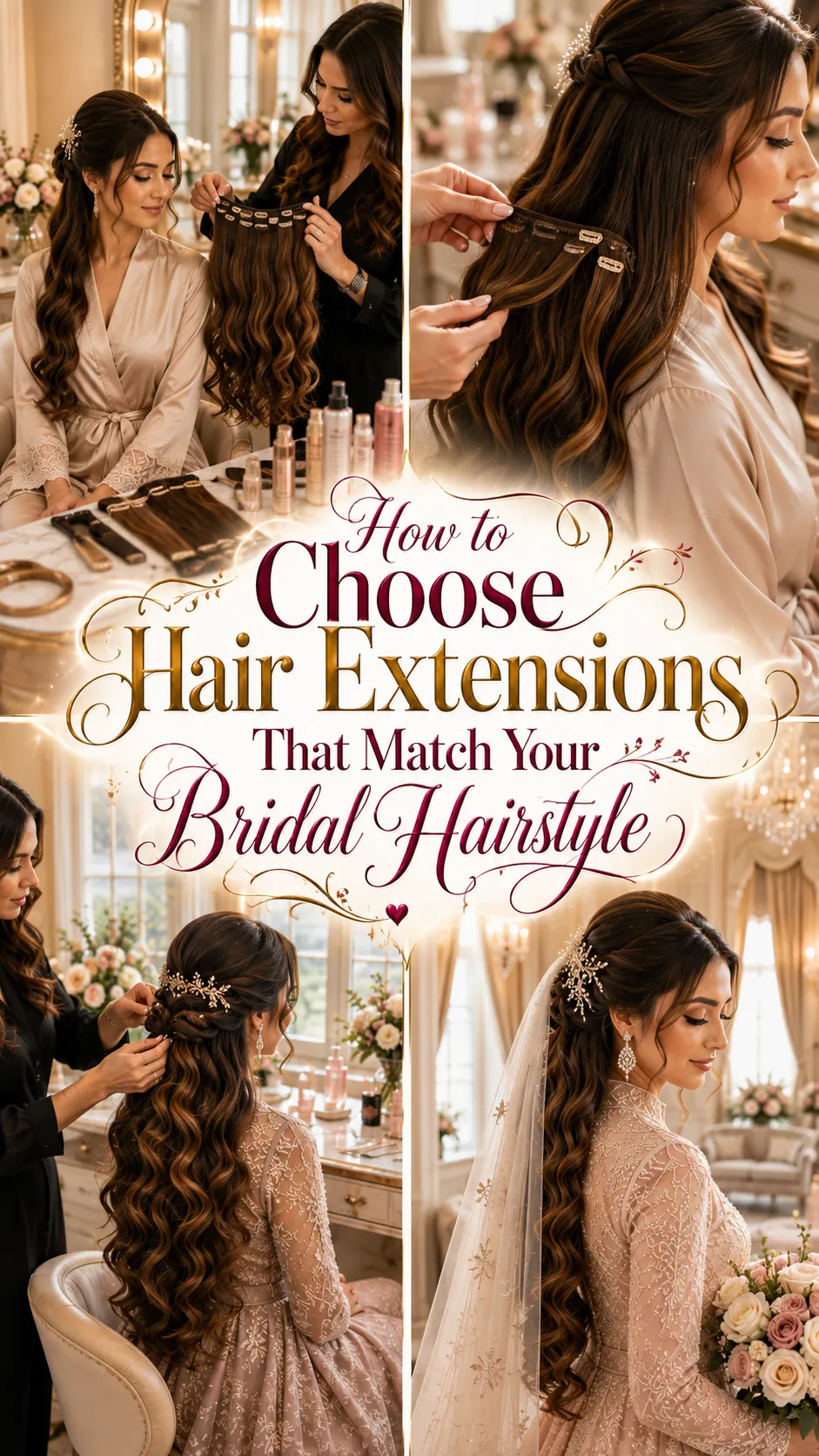
Hair extensions can completely transform a bridal hairstyle. They can add the length needed for cascading waves, the thickness needed for a full bun, or just enough volume to make a simple half-up style look fuller in photographs.
But here’s the catch: the wrong extensions can be surprisingly obvious.
A slightly different color, mismatched texture, bulky attachment, or excessive length can make an otherwise beautiful bridal hairstyle look less natural.
The goal isn’t simply to have more hair.
It’s to make your extensions look like they were always part of your hair.
Decide What Your Hairstyle Actually Needs
Don’t buy extensions first and choose the hairstyle afterward.
Choose the hairstyle you want, then figure out what your natural hair is missing.
Maybe you need:
- More length.
- More thickness.
- Fuller ends.
- Extra volume.
- Better shape.
- A stronger foundation for an updo.
- More hair to create braids.
- Additional fullness around the face.
This matters because you don’t necessarily need extremely long extensions.
Sometimes your natural hair already has enough length but needs extra density.
For example, a low bun may look completely different with volume extensions than it would with very long extensions.
More length isn’t always the answer.
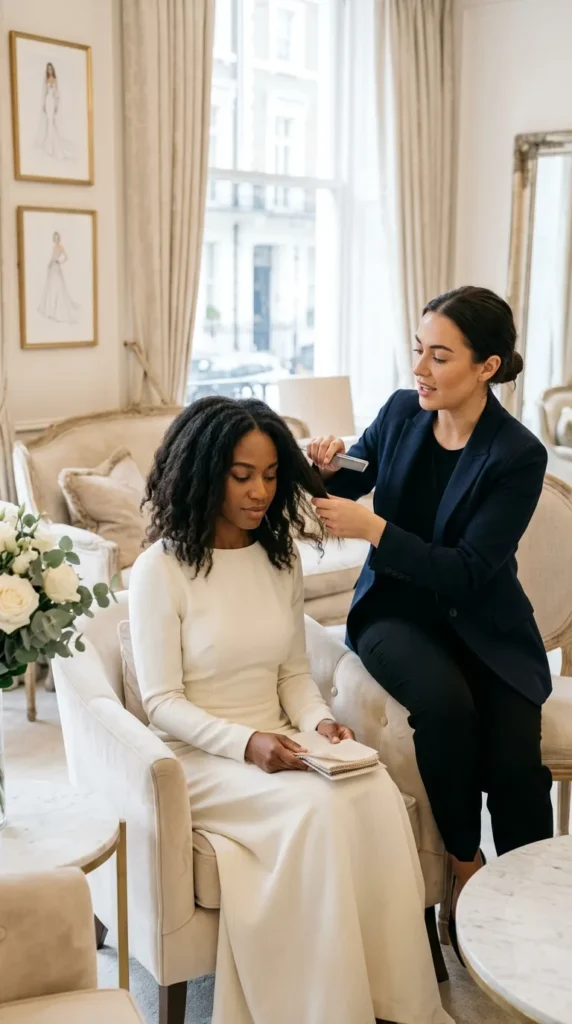
Match the Color in Natural Light
Color matching is one of the most important parts of choosing bridal extensions.
Don’t match your extensions under yellow salon lighting and assume they’ll look identical everywhere.
Check the color in:
- Natural daylight.
- Indoor lighting.
- Your wedding venue lighting, if possible.
- Photos taken with your phone.
Look at the extensions beside your actual hair—not separately.
Pay attention to undertones too.
Your hair might look “brown,” but it could have:
- Warm golden undertones.
- Cool ash undertones.
- Neutral brown tones.
- Subtle red tones.
A close color match can still look noticeably different if the undertone is wrong.
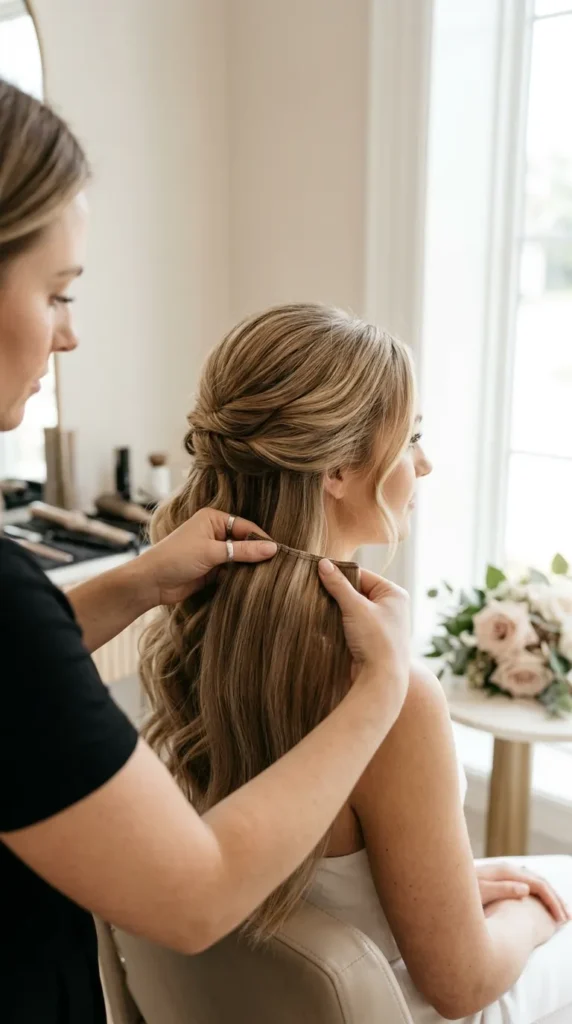
Consider Highlights and Balayage
If your hair isn’t one solid color, extensions may require more careful matching.
For highlighted or balayage hair, look for extensions that recreate the same pattern of light and dark rather than simply matching your darkest or lightest shade.
This creates a much more natural blend.
If you can’t find the perfect match, ask your hairstylist whether the extensions can be professionally colored.
Don’t attempt a major color transformation yourself right before the wedding.
Your bridal hair is not the place for a surprise chemistry experiment.
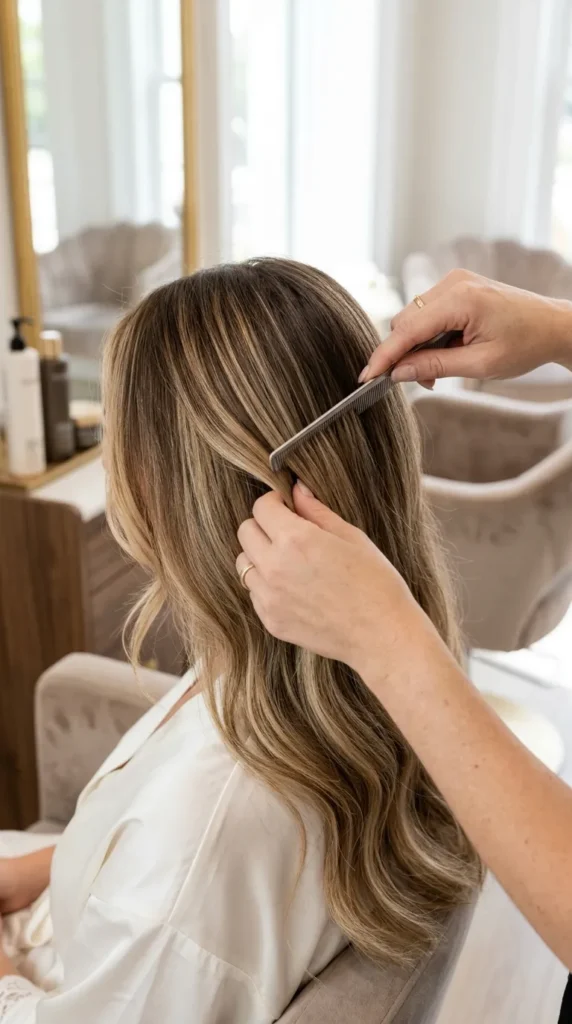
Match the Texture, Not Just the Color
This is where many extension mistakes happen.
Imagine your natural hair is softly wavy but your extensions are perfectly straight.
Even if the color is identical, the difference can become obvious.
Your extensions should work with your hair’s texture.
For:
Straight hair: choose extensions that can remain sleek or be styled smoothly.
Wavy hair: look for extensions that can be curled or waved to match your natural movement.
Curly hair: choose extensions designed to work with curly textures rather than forcing a completely different texture.
Your stylist can also blend the extensions into your natural hair through styling.
The final hairstyle should look like one continuous texture.
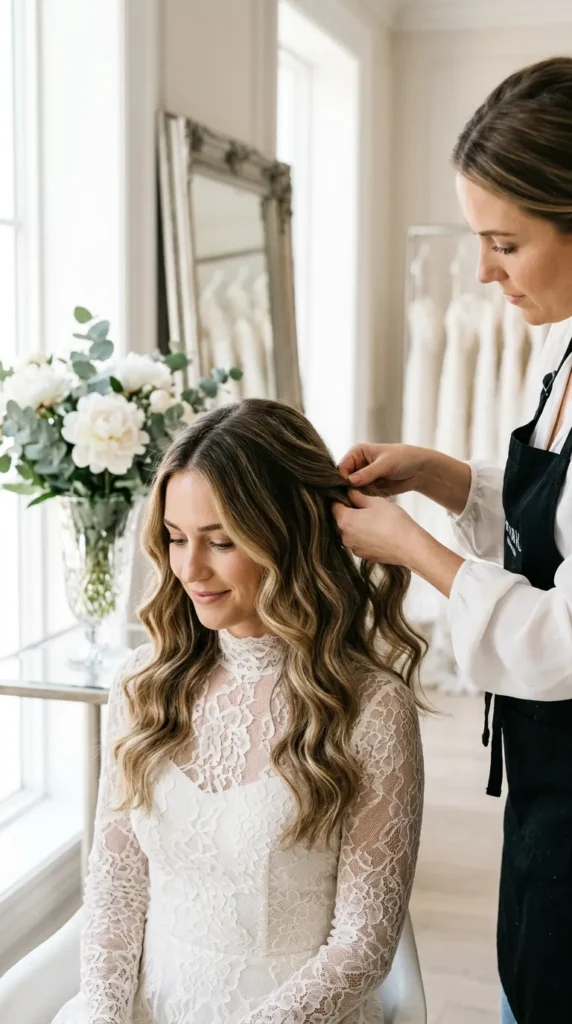
Choose the Right Extension Type
Not all extensions behave the same way.
For a one-day bridal hairstyle, temporary options are often convenient because they can be applied for the event and removed afterward.
Popular temporary choices include:
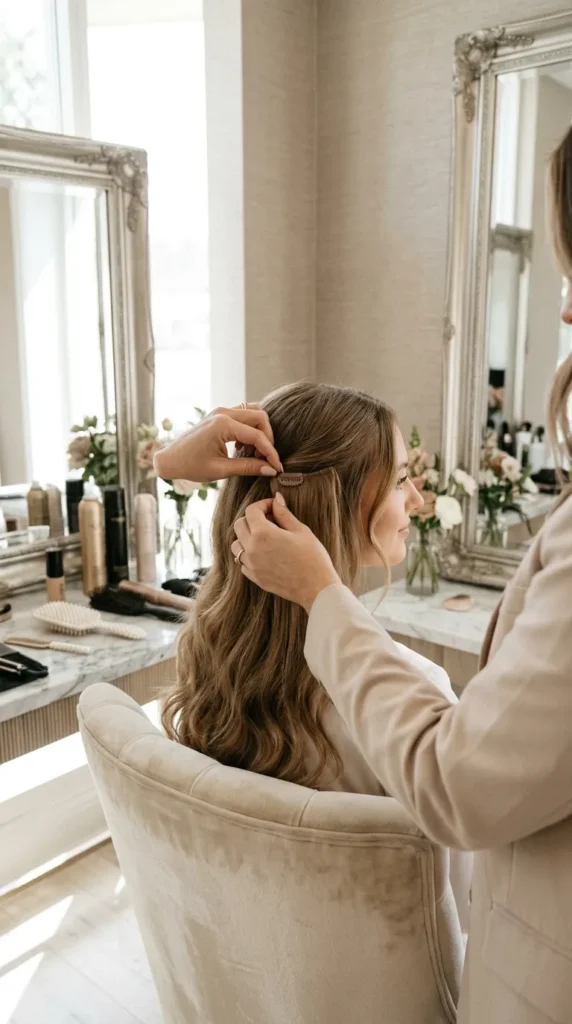
- Clip-in extensions.
- Clip-in ponytails.
- Halo-style extensions.
- Temporary hairpieces.
- Volumizing pieces designed for updos.
Clip-ins are especially versatile because your stylist can place them exactly where additional volume or length is needed.
The best choice depends on your hairstyle, natural hair, and stylist’s technique.
Test Them Before the Wedding
This should be non-negotiable.
Don’t wait until your wedding morning to discover that your extensions feel uncomfortable or don’t blend properly.
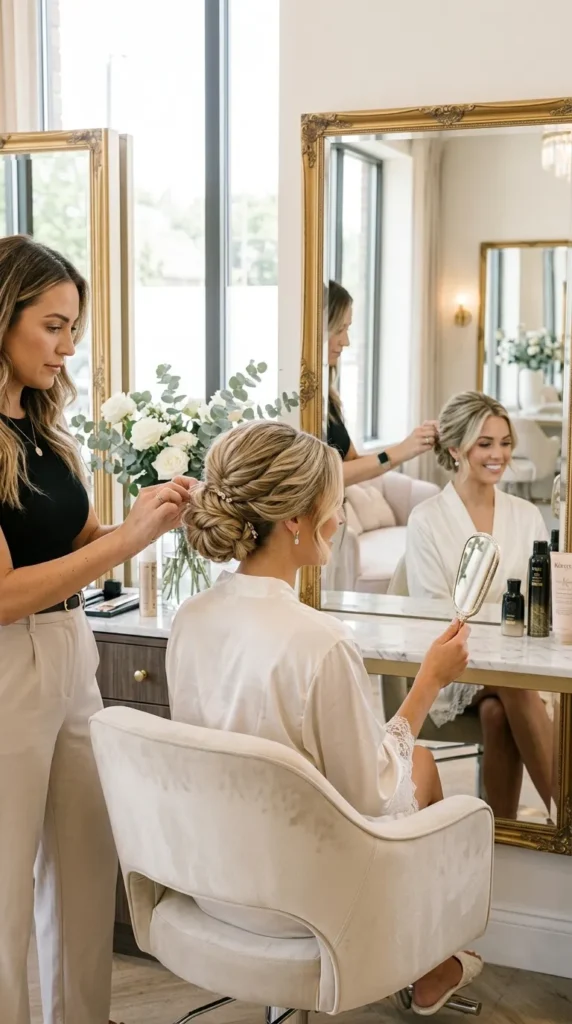
Bring your actual extensions to your bridal hair trial.
Have your stylist create the complete hairstyle.
Then:
- Look at it from every angle.
- Take photos.
- Wear it for several hours.
- Move your head.
- Sit down.
- Walk around.
- Try your veil.
- Check the attachment points.
If something doesn’t feel right, you still have time to adjust it.
Your trial isn’t just about deciding whether you like the hairstyle.
It’s your dress rehearsal for your hair.
Bring Your Veil to the Trial Too
This is especially important.
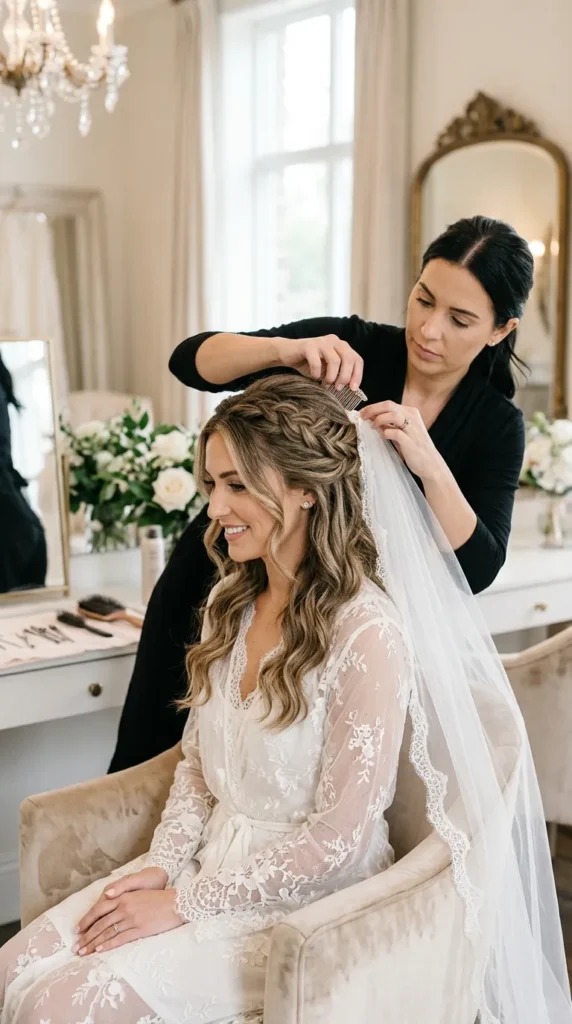
Your veil changes how your hairstyle looks and where the extensions need to be placed.
A cathedral veil may require a stronger attachment point.
A fingertip veil might sit differently.
A heavily embellished veil can add additional weight.
Your hairstylist needs to know where everything will go.
Bring:
- Your veil.
- Hair accessories.
- Tiara or headpiece.
- Any decorative pins.
- Your actual extensions.
Seeing everything together allows your stylist to create a hairstyle that works as one complete look.
Think About Your Face-Framing Pieces
Extensions aren’t only about the back of your hair.
They can also affect the pieces around your face.
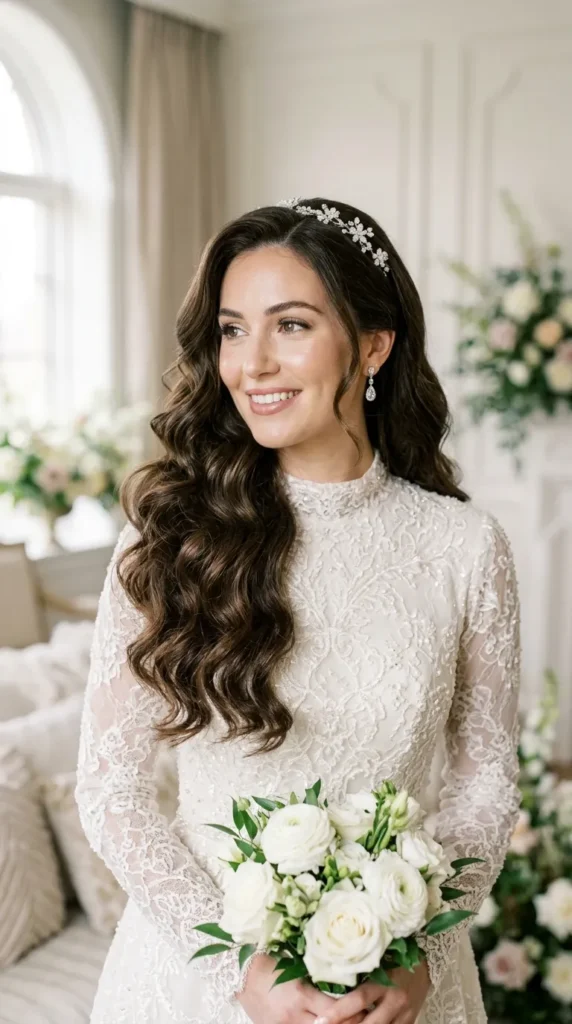
If you’re wearing soft waves, your stylist may use extensions to create fuller lengths while leaving your natural front sections visible.
This can help the hairstyle feel more believable.
The goal is usually to blend the extensions into your natural hair rather than creating an obvious “extension line.”
Face-framing layers can be especially useful for making the transition seamless.
Think About Your Wedding Dress
Your hairstyle and dress should complement each other.
A sleek fitted gown may look stunning with long, glossy extensions flowing down the back.
A romantic ball gown can work beautifully with a voluminous updo.
A minimalist satin dress may pair especially well with polished, healthy-looking waves.
Extensions give you flexibility, but don’t let them distract from the dress.
Your hairstyle should frame the gown rather than compete with it.
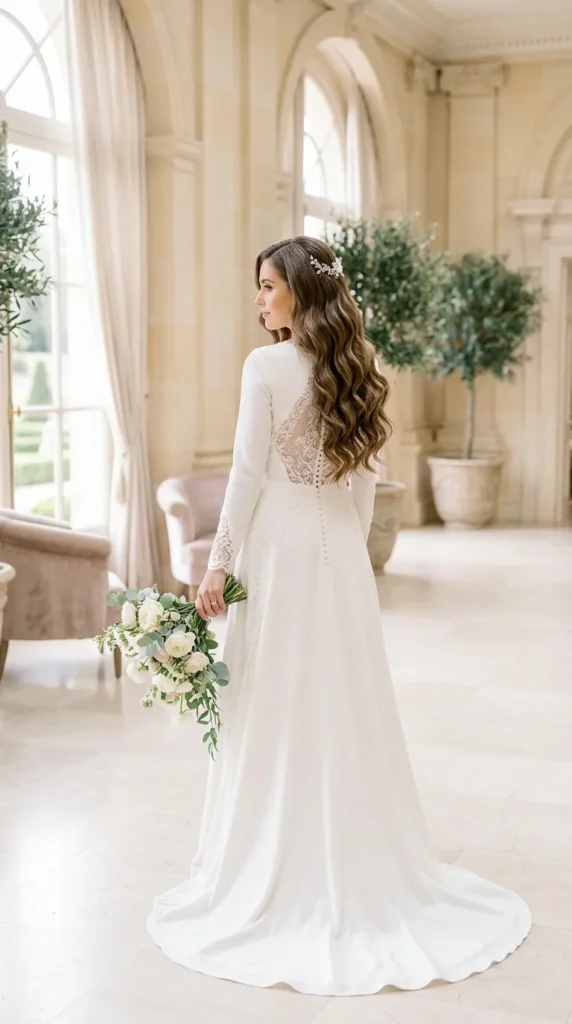
Choose Extensions for the Look You Want—Not the Look Everyone Else Has
Pinterest can make every bride want the same cascading, ultra-long hairstyle.
But your perfect bridal hair might be completely different.
Maybe you want:
- A sleek low bun.
- A soft chignon.
- A romantic half-up style.
- A polished ponytail.
- A thick braid.
- Shoulder-length waves.
Extensions should help you achieve your hairstyle.
They’re a tool—not a requirement.
If your natural hair already creates the shape you want, don’t add extensions simply because other brides are wearing them.
Sometimes the most beautiful result is the simplest one.
Conclusion
Choosing bridal hair extensions is about much more than adding length. The right extensions should match your natural hair color, undertone, texture, density, and overall hairstyle while remaining comfortable enough to wear throughout your wedding day.
Start by deciding what your hairstyle actually needs. Then work with your hairstylist to choose the right extension type, length, weight, and placement.
Always test the extensions during your bridal hair trial, and bring your veil and accessories so everything can be styled together.
Most importantly, don’t chase length just for the sake of having longer hair.
The best extensions are the ones nobody notices.
When your curls look naturally full, your bun has the perfect shape, or your braid suddenly looks beautifully thick, your guests shouldn’t be thinking about extensions.
They should simply be thinking:
“Her hair looks incredible.”